An ovulation predictor estimates the day your ovary releases an egg by counting back about 14 days from your next expected period. That estimate is a good starting point, but ovulation day moves from cycle to cycle. This page explains how prediction works, how reliable it is, and how to sharpen it with ovulation tests and body signs, especially if your cycles are irregular.
The short version
- Ovulation usually happens 12 to 14 days before your next period, whatever your cycle length.
- Your fertile window is the five days before ovulation plus ovulation day. The two days before ovulation are the most fertile.
- A calendar estimate gives a range. Ovulation tests, cervical mucus and a temperature chart narrow it down.
- With irregular cycles, predict from your shortest and your longest cycle and start testing early.
How ovulation is predicted
A cycle has two halves. The first half, before ovulation, varies a lot: it can be 10 days in one cycle and 20 in the next. The second half, from ovulation to the next period, is called the luteal phase and is much steadier, usually close to two weeks. So instead of counting forward from your last period, a predictor counts back from your next one:
- Find your next period. First day of your last period plus your average cycle length.
- Count back your luteal phase. Subtract 14 days, or your own luteal phase length if you know it from charting. The result is your estimated ovulation day.
- Mark the fertile window. The five days before ovulation and ovulation day itself.
The calculator below does these steps for three cycles. Open "Advanced" to enter your own luteal phase.
How reliable is a calendar prediction?
Less reliable than most people expect. In a well known study that measured hormones in daily urine samples, Allen Wilcox and colleagues found that only about 30 percent of women had their whole fertile window within days 10 to 17 of the cycle, the days often named in clinical guidelines. Some were fertile much earlier, others much later, and even women with regular cycles were not fully predictable.
That does not make the calculator useless. It tells you when to start paying attention. For an exact answer you need signals from your own body.
Ways to confirm the prediction
| Method | What it shows | Timing |
|---|---|---|
| Calendar estimate | A likely range based on past cycles | Ahead of time |
| Cervical mucus | Clear, slippery, stretchy mucus as ovulation nears | A few days before |
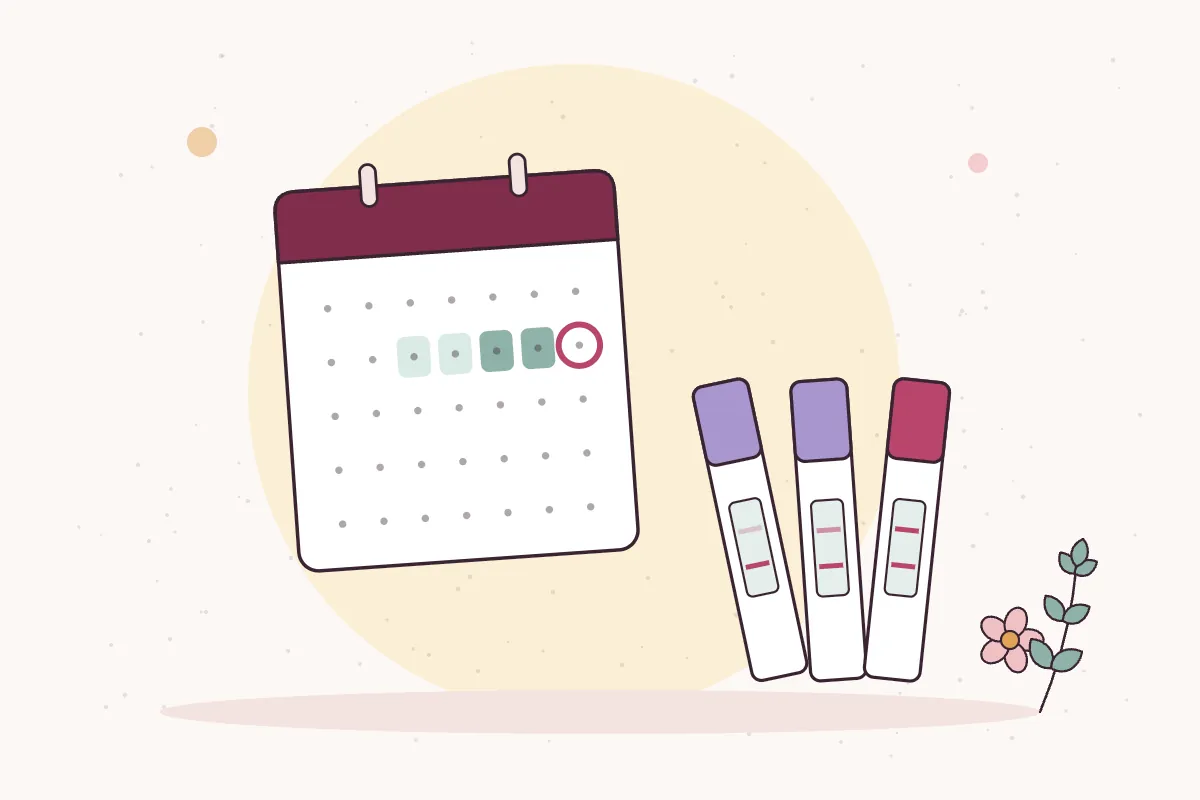
| LH ovulation test | The hormone surge that triggers ovulation | About 1 to 1.5 days before |
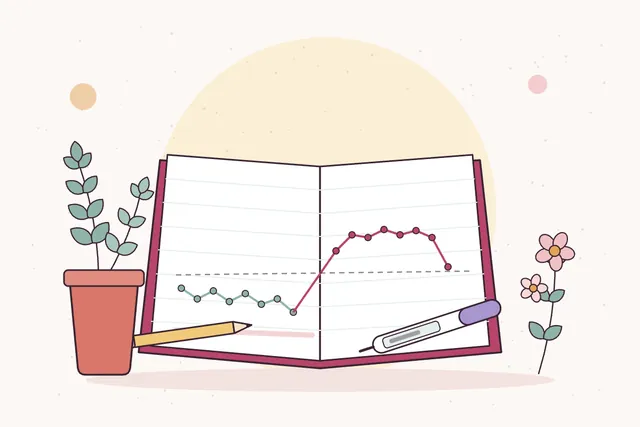
| Basal body temperature | A small rise caused by progesterone | After ovulation, confirms it happened |
Combining two methods works best: an LH test or mucus to see ovulation coming, and a temperature chart to confirm it afterwards. Our guides explain each one: how to use ovulation tests, the signs of ovulation and how to chart your cycle.
Predicting ovulation with irregular cycles
If your cycle length changes by more than a few days, one average will often be wrong. A simple way around this:
- Run the calculator with your shortest recent cycle. That gives the earliest your fertile window is likely to start, and the day to start testing.
- Run it again with your longest recent cycle. That gives the latest likely ovulation day.
- Treat everything in between as possibly fertile, and let tests or mucus tell you which day it is this time.
Very irregular cycles, or cycles longer than 35 days, can mean that ovulation does not happen every month. That is common with PCOS and thyroid problems and is worth discussing with a doctor, especially if you are trying to conceive.
Not birth control
No predictor can tell you a "safe" day. Ovulation can come early, and sperm can survive up to five days. If you want to avoid pregnancy, talk to a doctor or clinic about contraception.
When to see a doctor
- you are under 35 and have been trying to conceive for 12 months, or 35 or older and trying for 6 months
- you are over 40, or your periods are very irregular or absent: talk to a doctor before you start trying or soon after
- you never see a positive ovulation test or a temperature rise over several cycles
- you have severe or one-sided pelvic pain, especially with fever, vomiting or fainting
Frequently asked questions
Is ovulation always on day 14?
No. Day 14 is only typical for a 28 day cycle. With a 35 day cycle ovulation is closer to day 21, with a 24 day cycle closer to day 10. Read more in when do you ovulate.
Can I ovulate twice in one cycle?
Sometimes two eggs are released, but this happens within about a day, which is how fraternal twins come about. There is only one fertile window per cycle.
Do period tracking apps predict ovulation better?
Apps that only use your period dates do the same calendar calculation as this page. Apps that also record temperature, LH tests or mucus can be more accurate, because they use real signs from your body.
Sources
- Wilcox AJ, Dunson D, Baird DD, BMJ (2000): The timing of the "fertile window" in the menstrual cycle: day specific estimates from a prospective study
- Wilcox AJ, Weinberg CR, Baird DD, New England Journal of Medicine (1995): Timing of sexual intercourse in relation to ovulation
- American College of Obstetricians and Gynecologists: FAQ, Fertility Awareness Based Methods of Family Planning
- American College of Obstetricians and Gynecologists: FAQ, Evaluating Infertility
- NHS: Trying to get pregnant