Ovulation is the moment one of your ovaries releases a mature egg, usually once per menstrual cycle. The egg travels into the fallopian tube, where it can be fertilized for only about 12 to 24 hours. Because sperm can survive for several days, the days just before ovulation are the most fertile of your whole cycle. Everything else in the cycle, from your period to the changes in discharge you may notice, is organized around this one event.
The short version
- Ovulation is the release of one mature egg from an ovary, typically once per cycle.
- It is triggered by a sudden rise in luteinizing hormone (LH). Ovulation usually follows within about 24 to 36 hours.
- The egg lives about 12 to 24 hours; sperm can live up to about 5 days. That is why the fertile window is roughly six days long.
- The phase after ovulation (luteal phase) is fairly stable at around 12 to 14 days. The phase before it varies much more.
- Tracking ovulation is not reliable birth control unless you learn a formal fertility awareness method with trained guidance.
What happens during ovulation
You are born with all the eggs you will ever have. Each egg sits inside a tiny fluid-filled sac in the ovary called a follicle. According to the Merck Manual, there are about 1 to 2 million eggs at birth and roughly 300,000 by puberty, yet only about 400 are ever released over a reproductive lifetime. The rest gradually break down, which is normal.
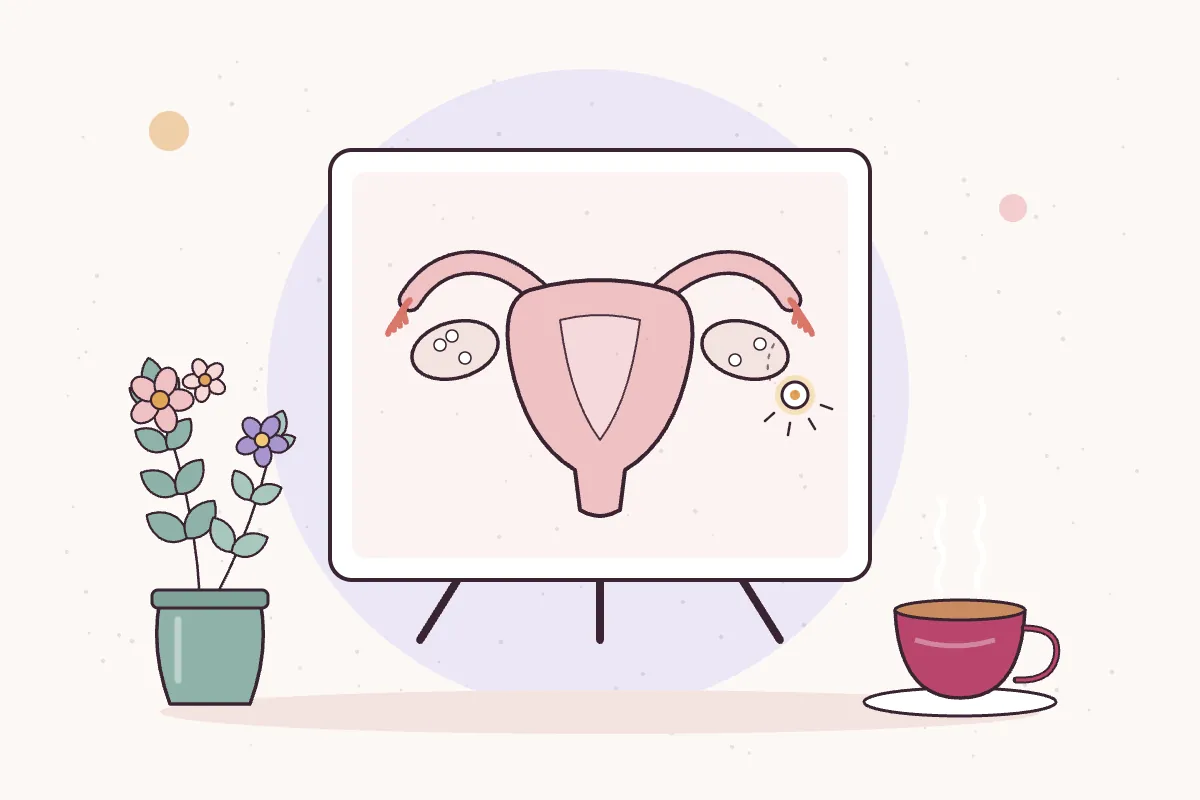
Each cycle, a group of follicles starts to grow. Usually one of them pulls ahead and becomes the dominant follicle, while the others stop growing. When the dominant follicle is mature, it bursts open and releases its egg. The finger-like ends of the fallopian tube sweep the egg inside, and it begins moving toward the uterus. If sperm are waiting in the tube, fertilization can happen there.
Ovulation alternates between ovaries in many people, but not in a strict pattern. One ovary can release the egg several cycles in a row. Occasionally two eggs are released in the same cycle, which is how fraternal twins happen.
The four hormones that run the show
Ovulation is the result of a back-and-forth between your brain and your ovaries. Four hormones do most of the work.
| Hormone | Made by | What it does in plain words |
|---|---|---|
| FSH (follicle stimulating hormone) | Pituitary gland in the brain | Wakes up a group of follicles at the start of the cycle and helps them grow. |
| Estrogen | Growing follicles | Rises as the follicles grow. Thickens the uterine lining and makes cervical mucus clearer, wetter and more stretchy, which helps sperm travel. |
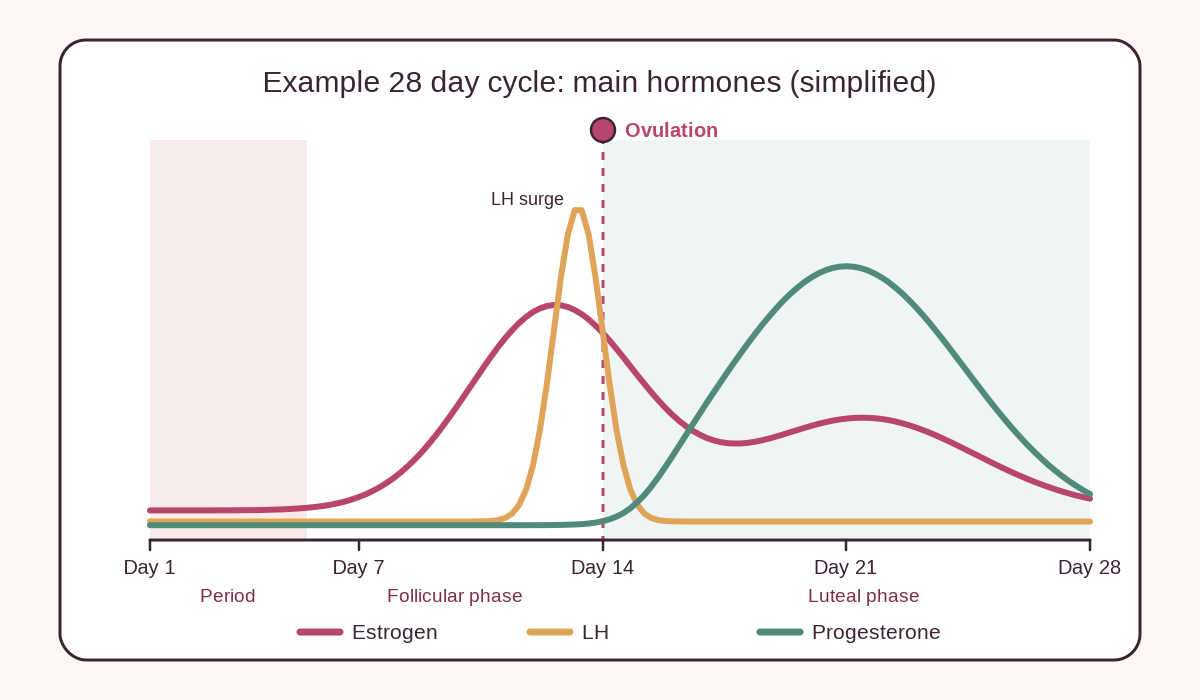
| LH (luteinizing hormone) | Pituitary gland | Surges sharply once estrogen is high enough. This surge is the trigger that makes the mature follicle release its egg. |
| Progesterone | Corpus luteum (the emptied follicle) | Rises after ovulation. Makes the uterine lining ready for a possible pregnancy and slightly raises your resting body temperature. |
The LH surge is also what home ovulation tests detect in urine. A positive test means ovulation is likely within the next day or so, which is why these tests are useful for timing sex. You can read more in our guide to ovulation tests.
The phases of the menstrual cycle
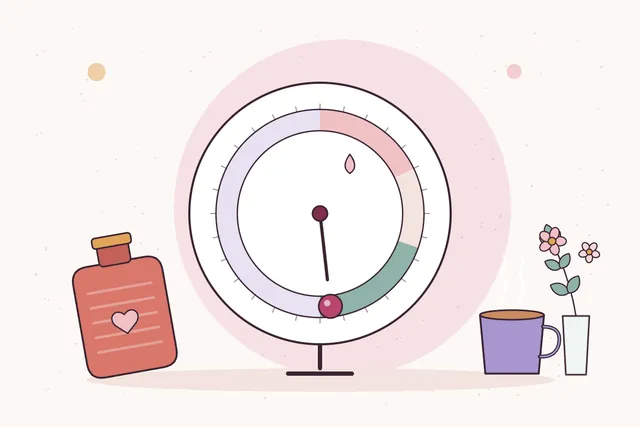
Doctors count day 1 of the cycle as the first day of full menstrual bleeding. From there, the cycle has two halves with ovulation in the middle.
Menstruation
Bleeding usually lasts about 3 to 7 days. The lining built up during the previous cycle sheds because no pregnancy happened and hormone levels dropped.
Follicular phase
This phase starts on day 1 and lasts until ovulation, so it overlaps with your period. FSH helps follicles grow, estrogen climbs and the uterine lining rebuilds. This is the part of the cycle that varies most in length. When a cycle is longer or shorter than usual, it is usually because this phase took more or less time.
Ovulation
The LH surge triggers the release of the egg. In a textbook 28 day cycle this is often shown on day 14, but a large app based study by Bull and colleagues (2019) found that only about 13 percent of cycles were exactly 28 days long, and ovulation day varied widely. Our guide on when you ovulate explains how to estimate your own day.
Luteal phase
The emptied follicle turns into a small gland called the corpus luteum, which produces progesterone. Cleveland Clinic describes an average luteal phase of 12 to 14 days. If an embryo implants, it starts sending a hormone signal that keeps the corpus luteum working. If not, the corpus luteum fades, progesterone and estrogen fall, and the next period begins.
How long the egg lives, and why that matters
Once released, the egg can be fertilized for about 12 to 24 hours. Sperm, on the other hand, can survive in the reproductive tract for up to about five days when fertile cervical mucus is present. Put together, this creates a fertile window of about six days: the five days before ovulation plus the day of ovulation itself.
A well known study by Wilcox and colleagues, published in the New England Journal of Medicine in 1995, followed 221 women trying to conceive. Pregnancies came only from sex during a six day span ending on the day of ovulation. The chance of conception was highest when sex happened in the two days or so before ovulation and on the day itself. In practice, this means that sex before ovulation matters more than waiting for signs that ovulation has already happened.
Practical tip
If you are trying to conceive, you do not need to pinpoint the exact hour of ovulation. Having sex every one to two days across your likely fertile window covers it well. Our free ovulation calculator estimates that window from your last period and usual cycle length.
Signs your body may give around ovulation
Many people notice some changes around ovulation, though not everyone does, and none of them is a guarantee:
- Cervical mucus becomes clear, slippery and stretchy, similar to raw egg white.
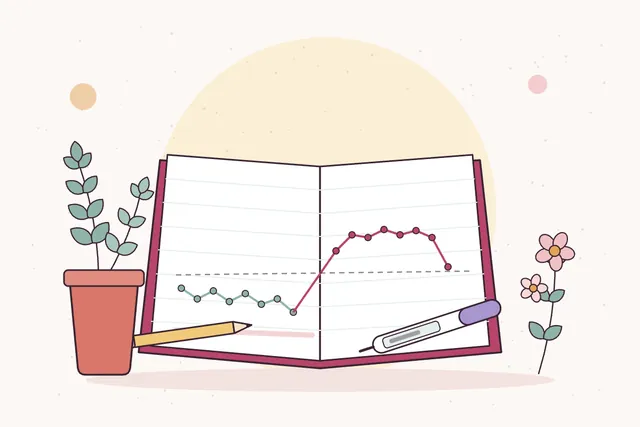
- A slight temperature rise of resting (basal) body temperature after ovulation, caused by progesterone.
- A brief twinge or ache on one side of the lower belly, sometimes called mittelschmerz.
- A positive LH test in the day or so before ovulation.
We cover how to use and read these clues in detail in signs of ovulation.
Is ovulation the same as having a period?
No. A period is the shedding of the uterine lining; ovulation is the release of an egg about two weeks earlier. Most periods follow an ovulation, but not all of them. Bleeding can happen in a cycle without ovulation, and ovulation can happen before your first period returns after childbirth or stopping some birth control. For the details, see our guide to ovulation and your period.
Why ovulation can be irregular or missing
Ovulation depends on a finely tuned hormone loop, so many everyday and medical factors can delay or block it. Cycles are often irregular in the first few years after periods start and again in the years before menopause. Other common reasons include breastfeeding, hormonal birth control, significant stress, very low body weight or intense training, polycystic ovary syndrome (PCOS), thyroid problems and high prolactin levels. Some of these are temporary and harmless; others are worth having checked, especially if you want to get pregnant.
When to see a doctor
- You have been trying to get pregnant for 12 months without success and are under 35, or for 6 months if you are 35 or older. Over 40, or with irregular or absent periods, talk to a doctor before you start trying or as soon as you can.
- You have missed three or more periods in a row and are not pregnant, or your cycles are regularly shorter than 21 or longer than 35 days.
- You have severe or one-sided pelvic pain, especially with fainting, dizziness, fever or vomiting. This can be a sign of an ectopic pregnancy, a ruptured cyst or a twisted ovary and needs urgent care.
- You have very heavy bleeding, bleeding between periods that keeps happening, bleeding after sex or any bleeding after menopause.
- You have a positive pregnancy test together with pain or bleeding.
Frequently asked questions
How long does ovulation last?
The release of the egg itself is quick. What matters for pregnancy is that the egg can be fertilized for about 12 to 24 hours afterward. The fertile window, which includes the days sperm can wait in the body, is about six days.
Can you ovulate more than once a cycle?
Sometimes two eggs are released within the same short time frame, which can lead to fraternal twins. A second, separate ovulation days later in the same cycle is not the usual pattern, because progesterone after ovulation suppresses further follicle release.
Does ovulation always happen on day 14?
No. Day 14 is an average from a textbook 28 day cycle. Ovulation often happens earlier or later, and it can shift from one cycle to the next even in people with fairly regular periods.
Can tracking ovulation be used as birth control?
Not on its own. Estimating ovulation with an app or calendar is not reliable contraception. Fertility awareness based methods can reduce the chance of pregnancy only when learned properly, ideally with a trained instructor, and they are still less effective than most other methods.
Sources
- Cleveland Clinic: Ovulation
- Cleveland Clinic: Menstrual Cycle (normal phases and hormones)
- Cleveland Clinic: Luteal Phase
- Merck Manual Consumer Version: Female reproductive system, how many eggs
- Wilcox AJ, Weinberg CR, Baird DD. Timing of sexual intercourse in relation to ovulation. New England Journal of Medicine, 1995
- Bull JR et al. Real-world menstrual cycle characteristics of more than 600,000 menstrual cycles. npj Digital Medicine, 2019
- American Society for Reproductive Medicine: Fertility evaluation of infertile women, committee opinion
- Mayo Clinic: Amenorrhea